Excerpt from The Firebird and Princess Vasilisa (http://www.widesky.org/stories_poetry/fire.html)
One day the huntsman went on his valiant horse to hunt in the woods. He rode and rode along the broad path, and suddenly he came upon a golden feather of the Firebird; it shone bright as a flame! The valiant horse said to him: "Take not the golden feather; if you take it, you will know trouble!"
There are several famous dualisms that have inspired the arts for centuries - the good over evil, love over death and ofcourse, beauty and the beast. What is beautiful is good, though its goodness is often threatened by the ugliness of evil.
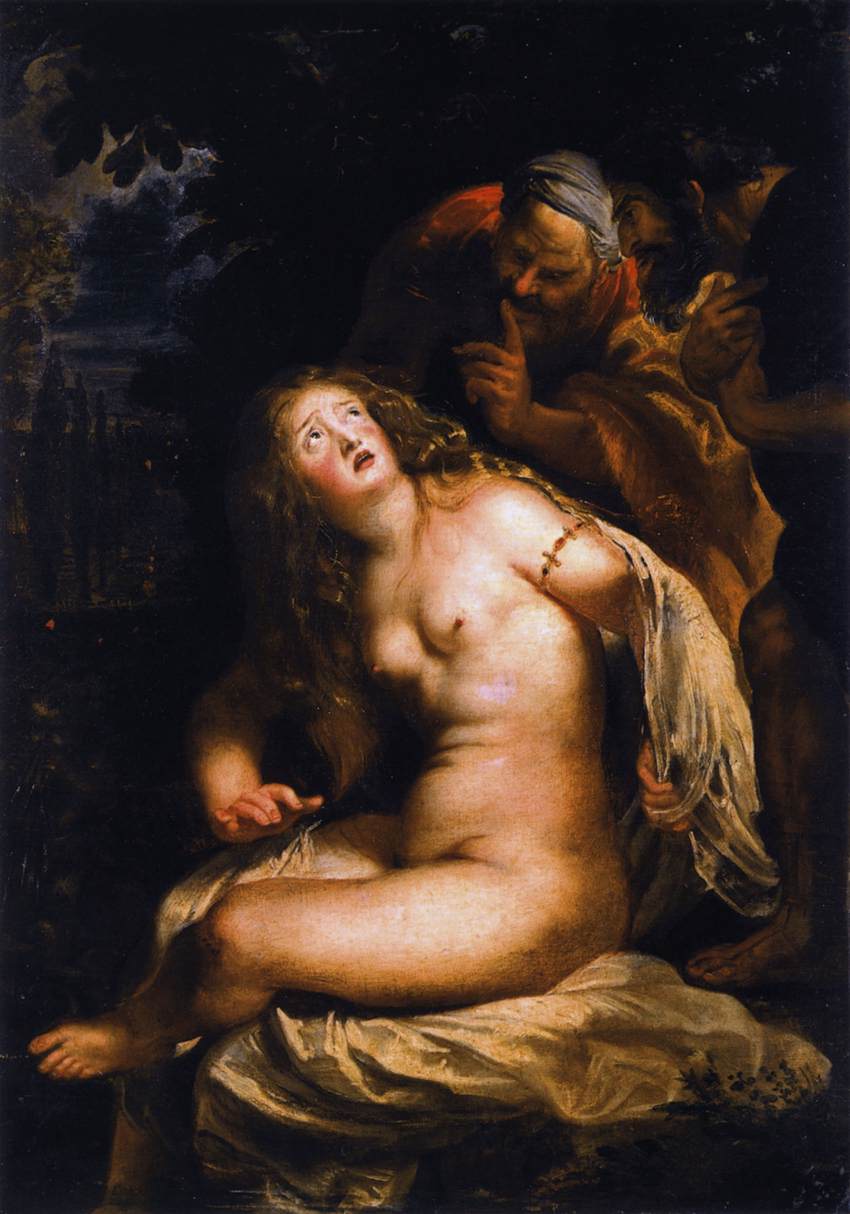
Peter-Paul Rubens, Susanna and the Elders, 17th c.
Yet the contrast between the beautiful and ugly is not nearly as thrilling as the moment in which they clash into a singular form. Oscar Wilde was aware of this fine line when he penned his only novel, The Picture of Dorian Gray, realising the role of art in creating this duality. Dorian Gray's portrait grows ugly as he retains his beauty but loses his soul. "There were moments when he looked on evil simply as a mode through which he could realise his conception of the beautiful"
Oscar Wilde, The Picture of Dorian Gray
I find one image that perfectly capture this incongruous moment. The swan.
Photo by Ed Buziak
A swan is an unparalleled symbol of the ugliness, violence and cruelty of beauty. We are blind to beauty's ugly origins, its shallow unfeeling nature and to its cruel behavior. We do not see the beast in the beauty just as we do not see the sinews and deformities of a ballerina's body, yet without the other, neither would exist. Therein lies the art.
Ship-wrecked figures on a raft, in complete darkness, with only the phosphorescence of the ocean waves breaking the ink-black of the pictures; in the distance, the fluctuating light of a lighthouse
The effect of passing auto headlights on the ceiling of a dark interior
Fluctuating neon or other electric signs
The light of a passing streetcar on an otherwise dark street
The hanging light on the ceiling of a cheap gambling joint
Searchlights of prisons or concentration camps
Flashes of guns in absolute darkness
The opening and closing of a refrigerator that has a light inside, in a dark kitchen
Looking at the images of the volcanic eruption in Iceland, there is nothing like a a very real subglacial volcanic eruption to create the ultimate fantasy form photograph - 3D effects, high contrasts, and a massive, celestial scale. However the question arises, is this why are we so enthralled by these photos? There must be more at play. I think about it in relation to one observation that I've made for years now - most people (regardless of their skill or interest in photography) have a tangible desire to photograph sunsets when they see them- this is not simply out of an aesthetic appreciation of their color and composition but it is out of a wonderment that something so seemingly majestic and divine can occur naturally and often. It is in the real that we seek the unreal. In these photographs we face the thrilling fear of looking at the chasm between a divine and yet godless universe.
Say that you are interested in photography and people immediately assume that you have a deep technical interest in the camera. They ask you about the equipment you use, the settings you prefer, the software you are indebted to and the printing style you employ. As a photography enthusiast I am deeply bored by such discussions - my general lack of interest in gadgets most certainly translates to cameras too. I simply see something I like and I photograph it. I hope for the best. My technical skill may be negligible but my aesthetic sense and curiosity often get me there. Seeing the current Miroslav Tichy exhibition at the International Center of Photography revealed for me the difference between photography as an artform rather than as a technology. For every bunch of photographers I see drooling over a new line of SLRs or comparing lens sizes, I am reminded of Tichy's makeshift cardboard cameras and their absurdly primitive technology. For every photographer I see painstakingly photoshopping the dust particles off their image, I see Tichy embracing the dirt, grime, bugs and visible signs of damage that characterize most of his photos. For every photographer that I hear bemoaning the focus mistakes in their shots, I see Tichy's fuzzy, blotchy and depthless images. For every crisp, perfectly framed and smiling portrait I see Tichy's cropped, voyeuristic shots of women's bodies. I love Tichy's work for the same reasons I love photography - the framing, the accidental effects, the element of chaos, and the capture of everyday life as a slice of utmost significance.
Eastern Promises (2007) is David Cronenberg's latest film, a sophisticated and shocking treatment of London-based Russian mafia. While generally received as an excellent film with a solid screenplay and direction, it is the deep symbolism that it delves into that takes into a level far above most of its crime-drama peers. In particular, Eastern Promises draws us into the world of the tattoo and the complex meaning it can have both a mark of stigma and pride. As one of the major sources for the development of this film, "Mark of Cain"(2000) documents the Russian tradition of tattoos that originate in jail, their relatively strict symbolism and their function as markers of an individual's criminal history, ethnicity and ofcourse identity. In one of the most memorable scenes of the film, Luzhin (played by Viggo Mortensen) is put under the filmic spotlight in which the tattoo inquisition 'reads' his history on his body. His incorporation into the Vory v Zakone must be the largest sacrifice - he must give himself wholly and in doing so receive the tattoo of the group on his chest and knees.
Ultimately the meaning of the tattoo is inextricably linked to Cronenberg's evolving concern with violence, whether it is ever truly justified but also whether it can ever really be erased from the individual or collective memory. In other words, it is the violent acts that we commit and we experience that remain permanently tattooed onto our psyche and write the history of who we are both as people and as nations. Similarly, the film in all its graphic excess actually features no gun violence - it is with the raping, injecting, stabbing and hacking of victims that Cronenberg creates that extremely intimate link between the victim and perpetrator of the violence - people inscribe their victims like the tattoo artist inscribes bodies.
Eastern Promises certainly has tattooed itself in my brain, and is one for the filmic canon....
Here's one to dispel the myths! Art can definitely be found in advertising.... The stunning Eva starts in this WKW directed ditty for Midnight Poison: A New Cinderella is Born.
A brief mention of the most incredible film-music collaborations of all time. Miles Davis' improvisations on Elevator to the Gallows (Ascenseur pour l'echafaud; Louis Malle, 1957) single handedly bring the unforgettable chilled cerebral loneliness of this classic new-wave film. His music somehow manages to be simultaneously intimate and distant, heartfelt and aloof - so much so that long after you have forgotten the plot, you will remember Jeanne Moreau's detached and desolate walk through the cold night lights of Paris.
A number of porcupines huddled together for warmth on a cold day in winter; but, as they began to prick one another with their quills, they were obliged to disperse. However the cold drove them together again, when just the same thing happened . . . In the same way the need of society drives the human porcupines together, only to be mutually repelled by the many prickly and disagreeable qualities of their nature. (Schopenhauer, 1851)
No satirist understands the bizarreness of the human condition better than Luis Buñuel. In his 1977 film That Obscure Object of Desirehe hilariously captures the conflicted nature of human relationships - our innate desire to be with another is perfectly opposed by innate desire to get away from them.
It's funny how seeing a simple Crowded House music video can start an entire thought process that traces its aesthetic heritage back 110 years. As I watched its dreamy black and white nonlinear narrative, with its doves, sleepwalkers, split images and celestial framing, it made me realize how much modern culture still ripples with Freudian imagery and Surrealist aesthetics.
Surrealism owes a substantial artistic debt to Freud, the man who first presented to us the concept of the unconscious, a submerged psychological iceberg full of taboo memories, thoughts and desires that ominously guides the greater part of our behavior. Some decades later, artists working in the surrealist tradition (Magritte, Ernst, De Chirico, Picabia, Dali) harnessed these groundbreaking ideas in realizing that art can be enhanced by the unconscious - both in creating and perceiving it.
Their greatest technique was in the way that they created works of art that depicted very real objects and images but that became other-worldly through their framing or juxtaposition or immersed in some strange impossible scenery. As the mind cannot make rational sense of it, the unconscious part becomes activated, forcing us into an entire new and very pleasurable state of consciousness.
Who might guess that this oddly constructed film about angels in Berlin could be so incredibly moving, a piece of cinema that is a poem at every level. Wim Wenders, unlike many auteurs both before and after him seems to realize that cinema communicates through all of sounds, words and imagery - in Wings of Desire these components are so meticulously constructed and intricately woven with each other that even the mere simpleton can for a moment experience synaesthesia.
The most notable scenes are those where we drift through public spaces able to hear the innermost thoughts of Berlin's citizens in all their mundanity, isolation and beauty - a collection of unrelated simultaneously occurring inner dialogues, filmed using a continuous take. At some point in time, you realize that this must also be what human consciousness is like - a million simple anonymous thoughts that coexist, unbroken in time.
The Dada movement in art is without a doubt my favorite. There is no other collection of artists and artworks that manages to be simultaneously controversial, macabre, hilarious and intriguing - they first poked fun at the established art of time and redefined the role of the artist and the viewer. When Europe was still shattered from the destruction of WWI, the Dadaists were able to make the kind of art that slaps you, destroys apathy and forces you to engage in a conversation - they were so ahead of their time that even encountering a Dada work today will be an unprecedented and often shocking experience. For every high school misfit that broods over Dali's "The persistence of memory" there is someone like me wanting to whack them over the head and point out Dali's predecessors - true rebels that were not afraid to start a revolution that unquestionably set the stage for modern art.
Man Ray on the other hand is without doubt one of my favorite photographers. While he was a Dadaist, in many ways he was also unlike them - firstly he was a Brooklynite in a world full of Europeans, a cool observer in a world of political activists and a photographer who also had financial success amongst artistic martyrs and anti-establishmentarians.
One of Man Ray's most unusual achievements is the way he saw his subjects in a new light, ripping apart all sentimentality when it comes to the human form and reducing it all to an object or shape. This obsession saw him experiment with new techniques - placing objects directly on photographic film, negative exposures and compositions and collages that linked the human body and the object-machine. The resulting works are always aesthetic but also unsettling - mirrors that reflect back to us the contents of our mind and yet remain coolly silent about Man Ray, the artist. Unconcerned, but not indifferent (written on Man Ray's grave).